

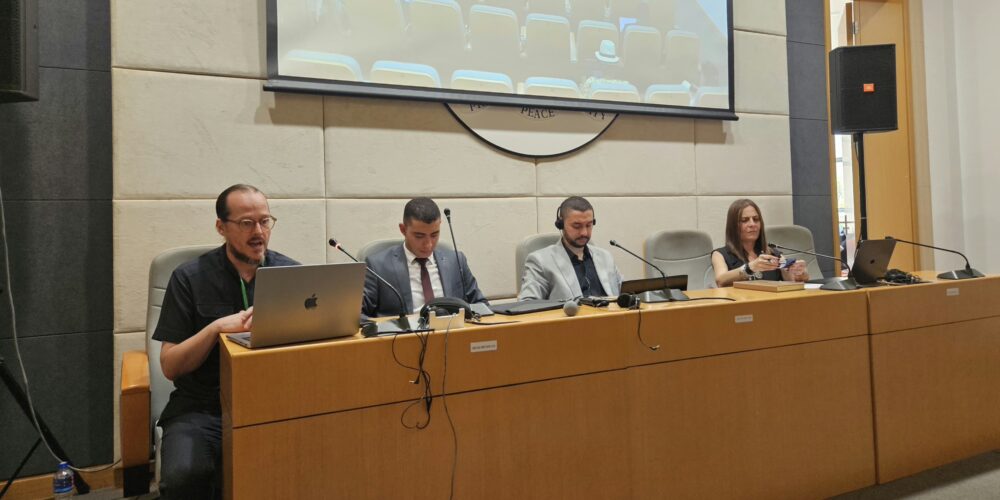
Banjul, 11 May 2026 — The Committee for Justice (CFJ), in partnership with the Pan African Lawyers Union (PALU), organized a side event entitled: “Judicial Independence Under Pressure: North Africa from a Continental Perspective” on the sidelines of the 87th Ordinary Session of the African Commission on Human and Peoples’ Rights, held in Banjul, The Gambia.
The event took place on Monday, 11 May 2026, from 13:30 to 15:00, in Press Room No. 3 at the Sir Dawda Kairaba Jawara International Conference Center, with simultaneous interpretation provided in English and French.
The discussion addressed the growing pressures facing judicial independence across Africa, with a particular focus on North Africa. Participants examined recent legal, constitutional, and institutional developments in Egypt, Tunisia, and Algeria, and their impact on the independence of courts, the protection of lawyers, and the ability of bar associations to carry out their professional and human rights roles free from interference and intimidation.
The session was moderated by Mr. François J. Godbo, Programs Director at PALU, and featured contributions from Commissioner Salma Sassi, Special Rapporteur on Tunisia at the African Commission; Mr. Montasser Salem, Director of the Democracy and Rule of Law Program at Intersection for Rights and Freedoms; Mr. Usame Mehmetoglu, Regional Officer at Committee for Justice; and Mr. Zakaria Ben Lharache, lawyer and Director of the Foundation for the Promotion of Human Rights.
Speakers emphasized that judicial independence is not merely an abstract institutional principle, but a fundamental safeguard for victims of human rights violations, detainees, lawyers, journalists, human rights defenders, and all those seeking justice.
Participants recalled that African Commission standards guarantee every person the right to appear before a competent, independent, and impartial tribunal, and guarantee lawyers the right to practice their profession free from intimidation or interference.
Regarding Egypt, discussions highlighted the continued use of exceptional and security-based judicial mechanisms, the expansion of prolonged pretrial detention and case recycling practices, as well as restrictions targeting lawyers and human rights defenders.
Committee for Justice reaffirmed its documentation of the central role played by the Supreme State Security Prosecution and arbitrary pretrial detention within broader patterns of repression. During the second half of 2025, CFJ documented 602 violations against detainees held in pretrial detention and 671 violations involving detainees in cases supervised by the Supreme State Security Prosecution. Participants also discussed the case of lawyer and human rights defender Osama Bayoumi, whose release orders were ignored before he was added to new state security-related cases, reflecting patterns of arbitrary deprivation of liberty without trial.
In Tunisia, participants expressed concern over the erosion of the rule of law, the concentration of powers in the hands of the executive branch, the weakening of institutional safeguards, and the targeting of judges, lawyers, and dissenting voices.
Discussions referred to concerns raised during Tunisia’s review before the African Commission, particularly regarding rule by decree, the marginalization of oversight institutions, and the weakening of independent monitoring mechanisms. Speakers also addressed violations targeting legal professionals, including the arrest of lawyers Sonia Dahmani and Mehdi Zagrouba inside the premises of the Tunisian National Bar Association, the arrest of lawyer and former Bar President Chawki Tabib, as well as harassment campaigns and prosecutions targeting Judge Anas Hamadi, President of the Tunisian Judges Association.
Participants further expressed concern over restrictions imposed on judicial professional associations and independent civil society actors.
Regarding Algeria, discussions focused on the gap between official discourse surrounding judicial reforms and the practical reality. Mr. Zakaria Ben Lharache explained that despite the formal guarantees provided by the 2020 Constitution and the new organic law on the status of judges adopted on 1 April 2026, the institutional structure governing the judiciary remains closely tied to the executive branch. He noted that the High Judicial Council continues to be chaired by the President of the Republic, while the Minister of Justice serves as Vice-President, and judges continue to be appointed through presidential decrees.
Participants also discussed provisions of the new law raising concerns about judicial independence, including restrictions on collective action by judges, limitations related to trade union activity, and provisions allowing judges to be transferred for “service necessities,” which could be used as tools of pressure. Concerns were also raised regarding the subordination of the Public Prosecution to the Ministry of Justice, particularly in cases involving freedom of expression, political activity, and the work of human rights defenders.
Discussions further highlighted the use of vague legal provisions, particularly Article 87 bis of the Algerian Penal Code, amended in 2021, which adopts an overly broad definition of terrorist acts including acts affecting national unity or institutional stability. Participants warned that these provisions are increasingly being used against journalists, activists, and human rights defenders.
Committee for Justice stressed that restrictions imposed on civil society in Algeria, together with politically motivated trials, arbitrary detention, and weak fair trial guarantees, demonstrate the urgent need for more effective regional follow-up by the African Commission and its special mechanisms.
Participants also discussed the future role that bar associations can play in defending judicial independence in the region. Mr. Zakaria Ben Lharache stressed the importance of professional solidarity when lawyers are prosecuted because of their defense work, the need for systematic documentation of violations targeting the legal profession, and the importance of making greater use of regional human rights mechanisms, including complaint procedures and periodic reviews before the African Commission.
He further called for strengthened continental solidarity and cooperation among African and Arab bar associations to ensure a collective cross-border response whenever lawyers are targeted or prosecuted because of their professional and human rights work. He emphasized that defending lawyers across the region should be viewed as a shared professional responsibility rather than an isolated domestic issue. He also stressed the need to confront self-censorship and fear in politically sensitive cases in order to preserve the independence of the legal profession and its role in protecting rights and freedoms.
The event also addressed the specific risks faced by women lawyers, judges, and activists, including smear campaigns, harassment, stigmatization, and the use of judicial proceedings to restrict their participation in public and professional life.
Participants stressed that targeting women working in legal and human rights fields not only harms them individually, but also weakens victims’ — especially women’s and vulnerable groups’ — access to justice.
During its intervention, Committee for Justice emphasized that any attack on judicial independence has direct consequences for victims. When courts are subjected to political pressure, when lawyers are intimidated or detained, and when bar associations are restricted, victims are deprived of effective access to justice and remedies.
Committee for Justice also stressed the importance of strengthening the role of the African Commission on Human and Peoples’ Rights in addressing threats targeting judicial independence and the legal profession, including through regional monitoring, activation of the focal point mandate on judicial independence in Africa, and enhanced cooperation with civil society organizations documenting violations related to the administration of justice.
The event provided an important platform for exchanging analysis and recommendations among lawyers, civil society organizations, and representatives of regional mechanisms on ways to protect courts, judges, lawyers, prosecutors, and bar associations from illegitimate interference, intimidation, and political pressure.
Participants further called on the African Commission to engage more systematically with issues relating to judicial independence in North Africa, including through the adoption of dedicated resolutions, deeper examination of these issues during state reviews, and direct dialogue with bar associations and legal professionals in the region.
At the conclusion of the event, Committee for Justice and the Pan African Lawyers Union reaffirmed that the independence of judicial institutions and the legal profession remains an essential condition for protecting victims, ensuring accountability, safeguarding fair trial guarantees, and preventing further deterioration of the rule of law in North Africa and across the African continent as a whole.