

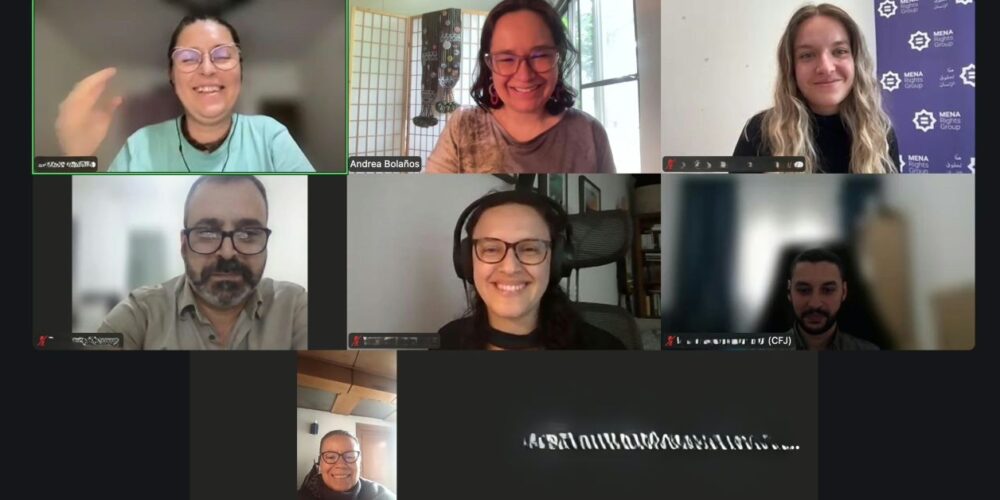
The Committee for Justice (CFJ) participated in an initial dialogue with Andrea Bolaños Vargas, the new United Nations Special Rapporteur on the situation of human rights defenders, her team, and civil society organizations working on North Africa.
The meeting provided an important space for exchange between the new mandate holder and regional civil society organizations on the main challenges facing human rights defenders, the protection gaps affecting their work, and possible avenues for continued engagement with the mandate.
Bolaños Vargas, a Colombian human rights expert, has extensive experience in research and advisory work with United Nations agencies, regional institutions, and civil society actors, including organizations working at international, regional, and grassroots levels. Her work has addressed migration, gender-related issues, and the protection of persons and communities exposed to human rights risks in Latin America.
CFJ was represented in the meeting by Usame Mehmetoglu, Regional Officer at CFJ, who delivered the organization’s intervention, and Asma Fatma Moatamri, Regional Officer for the Maghreb Region at CFJ.
During the meeting CFJ welcomed the Special Rapporteur’s recent engagement with civil society organizations working on North Africa, including her participation in a side event co-organized by CFJ on the situation of human rights defenders in North Africa. The side event was held on the margins of the 87th session of the African Commission on Human and Peoples’ Rights in Banjul, The Gambia.
CFJ stressed that one of the most alarming trends across several North African countries is the increasing normalization of reprisals and restrictions against human rights defenders. It warned that counter-terrorism and national security frameworks continue to be misused to criminalize legitimate human rights work, while defenders remain exposed to arbitrary detention, travel bans, asset freezes, digital surveillance, judicial harassment, smear campaigns, and transnational repression.
CFJ further noted that these violations often extend beyond defenders themselves, affecting their families inside their countries of origin and creating additional pressure on defenders working in exile or within diaspora communities.
In its recommendations, CFJ emphasized the importance of strengthening coordination between United Nations Special Procedures and regional human rights mechanisms, particularly the African Commission on Human and Peoples’ Rights, in line with the Addis Ababa Roadmap. CFJ underlined that such coordination is essential to ensure complementary protection efforts and more timely responses to reprisals and other serious violations targeting defenders.
CFJ also called for stronger rapid response and urgent intervention mechanisms in cases involving reprisals, arbitrary detention, enforced disappearance, and threats against human rights defenders. It further encouraged increased attention to transnational repression and digital surveillance, particularly where such practices are used to silence defenders outside their countries or intimidate their relatives at home.
CFJ also urged sustained attention to defenders operating in conflict settings, particularly human rights defenders in Sudan, who continue to face grave risks while documenting violations, supporting victims, and preserving civic space amid the ongoing conflict.
CFJ reaffirmed its readiness to continue engaging with the mandate and to support efforts aimed at strengthening the protection of human rights defenders across North Africa and the Sahel.