

The Sudan Rights Watch Network and the Committee for Justice (CFJ) are following with grave concern the continuing serious violations of human rights and international humanitarian law in El Obeid, the capital of North Kordofan State, amid systematic drone strikes and a looming siege by the Rapid Support Forces, which have targeted civilians for months. Condemning this escalating violence, the Network and the CFJ warn that the absence of meaningful international and regional action to protect civilians in the state, coupled with the continued impunity enjoyed by these forces, places the city on the brink of a humanitarian and human rights tragedy similar to that witnessed in El Fasher, the capital of North Darfur State, before its fall in late October 2025. We further reiterate that protecting civilians and holding perpetrators of violations accountable is not a political choice, but a binding legal obligation under international law.
Scale of the Humanitarian Crisis
Approximately half a million people currently live in El Obeid, including more than 100,000 internally displaced persons entitled to special protection under the international Guiding Principles on Internal Displacement. They have endured a siege lasting more than 18 months, which in itself constitutes a flagrant violation of the population’s rights to life and dignity and to access basic necessities, amid the rapidly accelerating collapse of essential services.
In recent days, UN and international agencies, including the International Organization for Migration, have warned of “another humanitarian catastrophe in the city,” stressing that the international community must not allow the atrocities committed in El Fasher and Zamzam over the past year to be repeated. The Network and CFJ recall that these repeated UN warnings place a legal and moral responsibility on international actors should their failure to take effective action continue, particularly as estimates indicate that the war in Sudan has so far killed at least 59,000 people and displaced around 13 million, while more than 30 million Sudanese now require some form of humanitarian assistance.
Documented Facts Reveal a Pattern of Serious Violations
In June 2026 alone, the UN recorded more than 15 drone attacks by the Rapid Support Forces on El Obeid and surrounding areas, killing more than 45 people. According to a UN report covering the period from January to the end of June 2026, drone attacks across the Kordofan region killed or injured at least 1,200 civilians, with strikes extending to public markets, medical facilities, and residential areas.
Field reports further indicate that at least 12 health facilities and one commercial market were destroyed or forced to close as a result of these attacks. Between 25 May and 25 June 2026 alone, eight fuel stations in El Obeid were targeted, bringing the total number of fuel stations attacked since mid-February 2026 to 19 stations. The El Obeid electricity substation also sustained direct damage, causing a four-day power outage, while the Grand Market and residential neighbourhoods were also damaged. The attacks further struck a center sheltering internally displaced persons and a secondary school, killing and injuring a number of female students.
Signs of a Looming Siege and a Worsening Health Crisis
The Rapid Support Forces’ repeated targeting of fuel stations, electricity infrastructure, and water sources is aimed at cutting the city’s vital supply lines in preparation for a suffocating siege mirroring that imposed on El Fasher. This is taking place amid the deployment of Rapid Support Forces around Bara and other villages, one of the most important sources of water supplying El Obeid.
The health crisis is worsening in parallel with the military escalation. Around 40% of health facilities in the city are now out of service, while approximately 825,000 children under the age of five across Sudan face the risk of severe acute malnutrition in 2026. In Kordofan, 911 cholera cases have been recorded, including 127 deaths, amid the growing spread of malaria, measles, and dengue fever as health and water infrastructure collapses.
Urgent Warning of a Repeat of the El Fasher Scenario
The recurring pattern of attacks against civilians and civilian infrastructure -from fuel and electricity facilities to markets, health facilities, and schools- reflects a systematic strategy aimed at subduing the population through starvation, cutting off their livelihoods, and depriving them of the most basic means of survival. This mirrors the pattern that preceded the fall of El Fasher and Zamzam camp for internally displaced persons, during which the Network and CFJ documented massacres and serious violations that claimed the lives of thousands of civilians. UN reports have explicitly stated that violations committed by the Rapid Support Forces in El Obeid may amount to war crimes and crimes against humanity. A legal characterization with direct consequences that require international criminal accountability, not merely political condemnation.
El Obeid’s strategic location as a vital link between the capital, Khartoum, the Darfur region, and other states of Sudan makes the city a key target for control over supply lines. This makes further escalation and a tightening of the siege likely in the coming period unless the international community acts urgently to end the siege and hold those responsible to account.
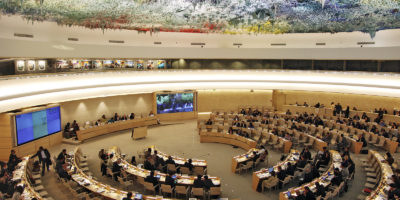
In this context, the two organizations welcome the adoption by the United Nations Human Rights Council of its resolution on the human rights situation in and around El Obeid, particularly its decision to mandate the Independent International Fact-Finding Mission for the Sudan to urgently investigate violations, including serious violations of international human rights law and international humanitarian law, and international crimes committed in and around the city. They stress that the effectiveness of the resolution will depend on its swift implementation, ensuring investigative mechanisms have access to victims and witnesses, preserving evidence, and providing the Fact-Finding Mission with the resources and support necessary to translate the resolution into practical steps towards protection and accountability.
In its oral intervention before the Human Rights Council during the urgent debate on El Obeid, CFJ called for the draft resolution to be strengthened to ensure the protection of civilians, preserve and reinforce the mandate of the Independent International Fact-Finding Mission for the Sudan, and ensure complementarity between international and regional mechanisms concerned with Sudan. During the closed consultations preceding the urgent debate, CFJ also submitted further recommendations stressing that any strengthened role for the Office of the High Commissioner should complement, rather than replace, the work of the Fact-Finding Mission, and encouraging the parties to the conflict to engage in good faith with the confidence-building measures proposed by the United Nations High Commissioner for Human Rights.
Legal Analysis of the Facts
The Sudan Rights Watch Network and CFJ present the following legal analysis as an objective basis for characterizing the violations set out above and for affirming that the situation in El Obeid is not a military conflict beyond legal scrutiny, but a direct breach of binding international obligations applicable to all parties to the conflict without exception.
Classification of the Conflict and Applicable Legal Framework
The ongoing conflict in Sudan, including the fighting in El Obeid and Kordofan, is classified as a non-international armed conflict under Common Article 3 of the four Geneva Conventions of 1949 and Additional Protocol II of 1977. Accordingly, all parties to the conflict -the State, armed groups, and all parties currently engaged in hostilities alike- are required to respect the rules of international humanitarian law, in particular the principles of distinction, proportionality, and precautions in attack, as well as the absolute prohibition on attacking protected persons and objects.
- Violation of the Principle of Distinction and the Protection of Civilian Objects
Customary international humanitarian law, including Rule 1 and 7 identified in the International Committee of the Red Cross study, requires parties to distinguish at all times between combatants and civilians, and between military objectives and civilian objects. The documented targeting of fuel and electricity facilities, water sources, markets, health facilities, schools, and centers sheltering internally displaced persons in El Obeid raises serious concerns of direct violations of the principle of distinction. Such attacks cannot be justified by military necessity unless these objects have in fact become lawful military objectives, which is not supported by the documented facts.
Starvation of Civilians and the Siege of Populated Areas as a Prohibited Method of Warfare
International humanitarian law expressly prohibits the starvation of the civilian population as a method of warfare, including in non-international armed conflicts, under Article 14 of Additional Protocol II and Rule 53 of the International Committee of the Red Cross study on customary international humanitarian law. This prohibition extends to attacking, destroying, or rendering useless objects indispensable to the survival of the civilian population, including water installations, power stations, and food and fuel supplies. The use of starvation and the deprivation of civilians of objects essential to their survival may constitute a war crime under customary international humanitarian law and may fall within the crimes set out in the Rome Statute where jurisdiction exists. The siege, which has continued for more than 18 months and has been accompanied by the systematic targeting of water sources, fuel, and electricity, raises serious concerns that starvation and the deprivation of essential services are being used as methods of warfare, warranting an independent investigation and effective accountability.
War Crimes and Crimes Against Humanity
In light of the explicit UN characterization that violations committed by the Rapid Support Forces in El Obeid may amount to war crimes and crimes against humanity, the documented acts -including the killing of civilians, attacks on protected objects, and violations committed along displacement routes- may fall within several provisions of the Rome Statute. These include murder (Article 8(2)(c)(i)); intentionally directing attacks against the civilian population (Article 8(2)(e)(i)); and attacks against buildings dedicated to religion, education, art, science or charitable purposes, and hospitals (Article 8(2)(e)(iv)). These acts may also constitute crimes against humanity under Article 7 if it is established that they were committed as part of a widespread or systematic attack directed against a civilian population, with knowledge of the attack.
Obligations of Third Parties and Arms-Supplying States
Documented reports of the continued cross-border flow of drones, spare parts, and military technology to parties to the conflict raise serious questions regarding the responsibility of supplying States under Articles 6 and 7 of the 2013 Arms Trade Treaty, which prohibit arms transfers where there is knowledge that the arms would be used to commit war crimes, crimes against humanity, or grave breaches of the Geneva Conventions. Depending on the circumstances, such transfers may also engage the international responsibility of a supplying State where they constitute a breach of an international obligation binding upon it.
International Responsibilities for Protection and Accountability
The Sudan Rights Watch Network and the Committee for Justice recall under the Responsibility to Protect framework endorsed in the 2005 World Summit Outcome, each State has the responsibility to protect its population from genocide, war crimes, ethnic cleansing, and crimes against humanity. The international community, through the United Nations, also has a responsibility to use appropriate diplomatic, humanitarian, and other peaceful means to help protect populations from these crimes and is prepared to take collective action through the Security Council, in accordance with the UN Charter, where peaceful means are inadequate and national authorities are manifestly failing to protect their populations. They further recall that Sudan is a party to the International Covenant on Civil and Political Rights, which guarantees the right to life under Article 6 and prohibits torture and cruel, inhuman or degrading treatment or punishment under Article 7. Both rights are expressly non-derogable under Article 4(2) of the Covenant, including during a public emergency threatening the life of the nation.
Urgent Demands Requiring Action
In light of the documented facts and the international legal framework set out above, we:
- Demand an immediate and unconditional halt to all drone attacks and indiscriminate bombardment by the Rapid Support Forces targeting civilians and protected civilian objects in El Obeid, as a legal obligation rather than a political choice.
- Call for the establishment of safe and sustained humanitarian corridors, backed by international guarantees, to deliver food, medicine, and fuel to the city’s population, and for an end to the use of starvation as a method of warfare prohibited under international humanitarian law.
- Urge the United Nations Security Council to take urgent and effective measures to ensure accountability, including by expanding the scope of the existing referral before the International Criminal Court or referring the situation in Sudan as a whole to the Court, including crimes committed in El Obeid and Kordofan; supporting the work of the Independent International Fact-Finding Mission for the Sudan; and encouraging States to exercise universal jurisdiction over persons suspected of responsibility for international crimes. We demand that States supplying weapons, drones, and military technology immediately halt such transfers, in compliance with their obligations under the Arms Trade Treaty and the international law of State responsibility.
- Call on UN, human rights, and humanitarian organizations to strengthen their documentation and operational presence inside El Obeid and to open independent and transparent investigations into the documented violations as a step towards accountability.
- Affirm the right of victims of these violations and their families to truth, justice, and reparation, an inherent right that is not subject to any statute of limitations.
The Sudan Rights Watch Network and the Committee for Justice stress that failure to act in response to what is happening in El Obeid today is not a neutral position; rather, it heightens the risk of a repeat of a tragedy that could have been prevented. We reiterate our warning that every day of delay in taking meaningful action brings the city closer to the fate of El Fasher, and we hold the parties to the conflict fully legally and morally responsible for any further deterioration in the situation.
Signatories
Sudan Rights Watch Network (SRWN)
Committee for Justice (CFJ)