

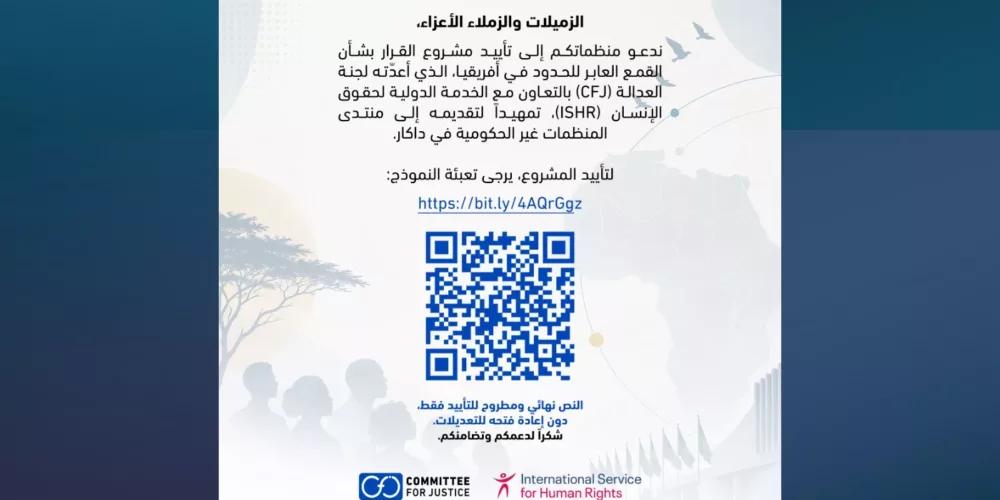
In cooperation with the International Service for Human Rights (ISHR), Committee for Justice (CFJ) has submitted a draft thematic resolution to the NGO Forum in Dakar. Already endorsed and signed by 40 African human rights organisations, the initiative calls on the African Commission on Human and Peoples’ Rights to establish a Joint Task Force and undertake a comprehensive continental study on transnational repression in Africa, with a view to developing effective mechanisms for prevention, protection, accountability and access to remedies.
Dakar, Senegal | 8 October 2026
Committee for Justice (CFJ), in cooperation with the International Service for Human Rights (ISHR), has presented a draft thematic resolution on Transnational Repression in Africa (TNR) to the NGO Forum taking place in Dakar, Senegal, from 8 to 10 October 2026, ahead of the 89th Ordinary Session of the African Commission on Human and Peoples’ Rights (ACHPR).
The draft resolution, which has already received the endorsement and signatures of 40 African human rights organisations, represents a collective effort to strengthen the African human rights system’s response to transnational repression as a growing threat to human rights defenders, journalists, political dissidents, refugees, asylum seekers and diaspora communities.
The initiative seeks to move beyond fragmented responses to individual cases and establish a coordinated African institutional framework for monitoring, documentation, prevention, protection, accountability and the development of human rights standards to address transnational repression.
Transnational Repression: Human Rights Violations Beyond National Borders
The draft resolution adopts a comprehensive understanding of transnational repression as measures taken by States, directly or indirectly, within or outside their territories, to silence, intimidate, punish, coerce or control individuals and communities abroad because of their actual or perceived opinions, beliefs, identities or activities, including the exercise and defence of human rights.
It recognises that transnational repression can take multiple forms, including threats and intimidation, digital surveillance and spyware, cyberattacks, harassment of family members and associates in countries of origin, and the misuse of criminal justice systems, counter-terrorism legislation, national security measures and international law enforcement cooperation.
Such practices may also involve restrictions on passports, nationality and consular services, as well as the misuse of extradition, deportation and immigration procedures, including INTERPOL Notices and Diffusions.
More severe forms of transnational repression may include abduction, arbitrary detention, enforced disappearance, torture and extrajudicial killings with a cross-border dimension.
The draft further highlights that the consequences extend beyond directly targeted individuals, affecting their families and communities and creating a broader climate of fear, isolation and self-censorship among diaspora and exile communities.
Establishing a Joint African Task Force on Transnational Repression
A central proposal of the draft resolution is for the African Commission to adopt a dedicated resolution recognising transnational repression as a distinct and growing human rights concern in Africa.
It further calls for the establishment of a Joint Task Force on Transnational Repression in Africa, coordinated by the Chair of the African Commission and bringing together relevant Special Mechanisms, particularly:
-
The Special Rapporteur on Human Rights Defenders and Focal Point on Reprisals in Africa.
-
The Special Rapporteur on Refugees, Asylum Seekers, Internally Displaced Persons and Migrants in Africa.
-
The Special Rapporteur on Freedom of Expression and Access to Information in Africa.
-
The Working Group on the Death Penalty, Extrajudicial, Summary or Arbitrary Killings and Enforced Disappearances in Africa.
The proposed Task Force would bring together complementary mandates to ensure that transnational repression is addressed through a coordinated, multidisciplinary and victim-centred approach.
A Continental Study to Inform New African Human Rights Standards
The draft resolution proposes mandating the Joint Task Force to undertake a comprehensive continental study on transnational repression in Africa, examining the nature, scale, patterns, methods and perpetrators of such practices, including those who order, facilitate or carry out violations.
The study would specifically examine the misuse of international security and judicial cooperation mechanisms, counter-terrorism and organised crime measures, digital surveillance, reprisals against family members, and the particular risks faced by refugees, asylum seekers and human rights defenders in exile.
It would also assess existing legal and institutional gaps, identify good practices, and examine the respective responsibilities of States that perpetrate or facilitate transnational repression and States in whose territories targeted individuals reside.
The proposed process would include broad, safe and meaningful consultations with victims, survivors, civil society organisations, diaspora communities, refugee-led organisations, national human rights institutions and relevant regional and international actors.
The study’s findings would provide a basis for recommendations to the African Commission, including the possible development of African principles, guidelines or other normative standards on transnational repression, and consideration of whether a dedicated permanent Working Group or other Special Mechanism should be established.
Strengthening State Responsibilities, Protection and Accountability
The draft resolution emphasises that African States have obligations under the African Charter on Human and Peoples’ Rights and other applicable international human rights standards to refrain from committing, supporting or facilitating acts of transnational repression.
States must also take appropriate measures to protect individuals within their jurisdiction against acts committed by foreign State agents or other actors.
The resolution calls for stronger legal, administrative and institutional safeguards to prevent the misuse of immigration procedures, extradition arrangements, counter-terrorism measures and international law enforcement cooperation for politically motivated persecution or other forms of transnational repression.
It further stresses the importance of respecting the principle of non-refoulement and ensuring enhanced scrutiny and independent review of cross-border arrest, extradition and deportation requests, particularly where human rights defenders, journalists, political dissidents, refugees or asylum seekers may be at risk.
The initiative also calls for accessible, secure and confidential reporting mechanisms, independent and effective investigations, accountability for perpetrators, and comprehensive remedies for victims, including compensation, rehabilitation and guarantees of non-repetition.
Strengthening Cooperation Between African and UN Human Rights Mechanisms Under the Addis Ababa Roadmap
The draft resolution places particular emphasis on strengthening cooperation between the African Commission and United Nations human rights mechanisms, especially UN Special Procedures, under the Addis Ababa Roadmap.
It calls for practical cooperation through information-sharing, coordinated monitoring, joint statements, urgent interventions, thematic consultations and engagement on individual cases and broader patterns of transnational repression.
Special attention is given to intimidation and reprisals against individuals and organisations who cooperate, seek to cooperate or have cooperated with African, United Nations or other international and regional human rights mechanisms.
CFJ considers this cooperation an important opportunity to strengthen the complementarity of African and international protection mechanisms and ensure that national borders do not become barriers to protection, justice or accountability.
A Call for Collective African Action
Committee for Justice considers the endorsement of the draft resolution by 40 African human rights organisations to date an important demonstration of growing civil society engagement with the need for a comprehensive African response to transnational repression.
The initiative highlights the importance of addressing transnational repression as a human rights issue, rather than exclusively through national security, counter-intelligence, foreign interference or counter-terrorism frameworks.
CFJ calls on African and international human rights organisations, national human rights institutions, relevant African Union bodies and international human rights mechanisms to support the initiative and contribute to a coordinated continental response grounded in the experiences and protection needs of victims and affected communities.
CFJ further calls on the members of the African Commission on Human and Peoples’ Rights to consider the draft resolution and the recommendations emerging from the NGO Forum during the Commission’s 89th Ordinary Session, and to take concrete steps towards adopting a dedicated African resolution establishing a sustainable institutional process to prevent and address transnational repression.
The protection of human rights defenders, journalists, refugees and other individuals at risk must not end at national borders. Leaving one’s country must never mean losing the right to safety, freedom, dignity and protection from persecution.
Committee for Justice reaffirms its commitment to working with the International Service for Human Rights and African civil society partners to mobilise support for this initiative and strengthen the capacity of African human rights mechanisms to document, prevent and respond to transnational repression and ensure accountability for violations.
Call for Endorsements: Sign the Draft Resolution
To broaden support for this initiative, Committee for Justice invites all African and international civil society and human rights organisations that have not yet signed the draft resolution to join the 40 organisations that have already endorsed it.
Additional endorsements will help strengthen collective advocacy for the adoption of a dedicated resolution by the African Commission on Human and Peoples’ Rights during its 89th Ordinary Session in Dakar.
CFJ emphasises that expanding the coalition of supporting organisations is an important step towards building a coordinated African human rights response, securing institutional recognition of transnational repression, and advancing effective mechanisms for victim protection, prevention and accountability.
We invite your organisation to add its endorsement and join this collective African initiative to ensure that human rights protection extends beyond borders.