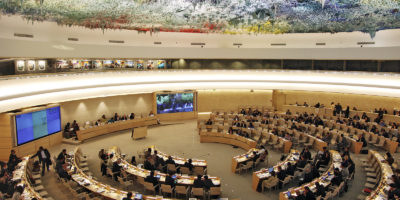


Geneva, 14 September 2026 – The United Nations Working Group on Enforced or Involuntary Disappearances (WGEID) organized a high-level side event at the Palais des Nations in Geneva, convened by the Committee for Justice (CFJ), entitled “Building Stronger Partnerships Between Human Rights Mechanisms and Civil Society in Africa: The Future of the Addis Ababa Roadmap and Human Rights Cooperation Across Africa.”
The event brought together representatives of African and United Nations human rights mechanisms, civil society, and human rights defenders to discuss the implementation and future of the Addis Ababa Roadmap, with particular attention to strengthening cooperation and complementarity between the African Commission on Human and Peoples’ Rights (ACHPR) and United Nations human rights mechanisms.
The discussion was moderated by Clément Nyaletsossi Voule, former UN Special Rapporteur on the rights to freedom of peaceful assembly and of association. The panel included Aua Baldé, member of the WGEID; Commissioner Idrissa Sow, Chairperson of the ACHPR; Commissioner Litha Musyimi-Ogana, member of the ACHPR; Ahmed Mefreh, Executive Director of CFJ; and Usame Mehmetoglu, Regional Officer at CFJ.
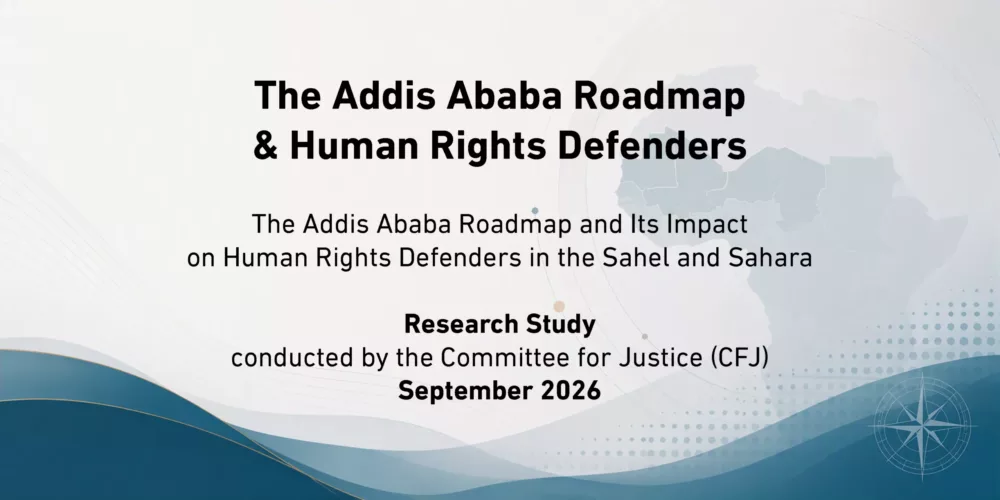
During his intervention, Usame Mehmetoglu presented the main findings and recommendations of CFJ’s research paper, “The Addis Ababa Roadmap and Its Impact on Human Rights Defenders in the Sahel and Sahara.” He highlighted the gap between the Roadmap’s potential as a framework for cooperation and its practical implementation, including limited awareness among human rights defenders, inconsistent institutional coordination, resource and capacity constraints, political and security barriers, and weaknesses in follow-up on recommendations and decisions.
Mehmetoglu also stressed the importance of moving towards more structured and sustained cooperation between African and UN human rights mechanisms, strengthening the participation and protection of human rights defenders and civil society, improving information-sharing and follow-up, and ensuring that cooperation under the Roadmap produces tangible results for rights-holders.
During his intervention, Ahmed Mefreh, Executive Director of CFJ, stressed that one of the Roadmap’s central challenges is its limited visibility among human rights defenders themselves. He noted that many defenders, particularly those working at the grassroots level or in restrictive and conflict-affected environments, are either unfamiliar with the Roadmap or do not see clearly how it can support their day-to-day engagement with African and UN human rights mechanisms. For the Roadmap to become more effective, he emphasized that it must be better understood, more accessible, and more closely connected to the practical protection needs of defenders and victims.
The discussion provided an opportunity for representatives of regional and international mechanisms and civil society to reflect on the Roadmap’s achievements, remaining challenges, and possible steps towards making cooperation between the African and UN human rights systems more systematic, accessible, and responsive to the needs of human rights defenders across Africa.
Read CFJ’s full research paper: The Addis Ababa Roadmap and Its Impact on Human Rights Defenders in the Sahel and Sahara