

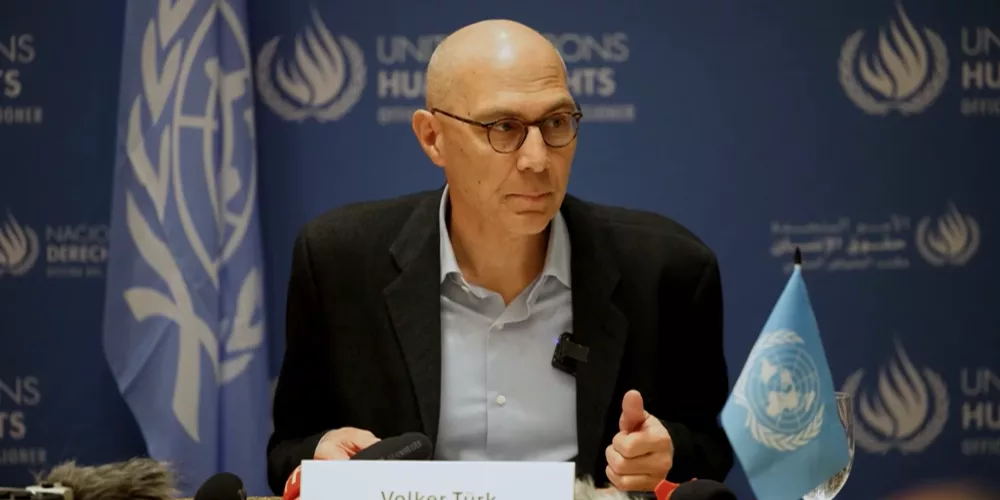
The Committee for Justice (CFJ) reports that the UN High Commissioner for Human Rights, Volker Türk, stated during a press conference held on 18 January in Nairobi, following the conclusion of his visit to Sudan, that the ongoing war has “pushed Sudan into an abyss of unimaginable proportions, affecting the entire country and its population.”
Türk explained that his five‑day visit included stops in Port Sudan, Dongola, and the localities of Al‑Dabbah and Merowe in the Northern State. He emphasized that what he witnessed reflects the scale of the humanitarian tragedy, yet also revealed the extraordinary resilience of the Sudanese people.
The High Commissioner affirmed that the “spirit of struggle for peace, justice, and freedom remains unbroken despite nearly three years of brutal war against civilians,” adding that he had witnessed “indescribable shock at the atrocities committed, but also the strength and determination of the human spirit.”
Türk met with youth activists working as first responders to the needs of their communities—organizing and delivering aid despite overwhelming bureaucratic obstacles and the risk of arrest and violence. He stressed that these youth continue their efforts knowing they “cannot stop the war, but are doing what they can to keep civilians alive.”
He also met with women‑led organizations providing legal assistance and humanitarian support to women affected by war‑related abuses—despite facing grave risks themselves.
Türk described the situation in Sudan as a “vast record of cruelty,” calling on all actors with influence—especially those supplying weapons to the warring parties or benefiting economically from the conflict—to take urgent action to stop the war. He warned that silence in the face of such atrocities “should shock the global conscience.”
He recounted harrowing testimonies, including children who lost their ability to hear or even smile due to shelling, and women who lost their sons and suffered looting, beating, abduction, and torture while attempting to flee. He highlighted the testimony of a 20‑year‑old displaced woman from El‑Fashir, who recounted the killing of her brother and being forced into silence during a sexual assault—an incident Türk said represents a much wider pattern.
Türk stated that “the bodies of women and girls have been turned into a battlefield,” stressing that sexual violence is being used as a weapon of war in Sudan, with increasing evidence that it is widespread and systematic, constituting a war crime and a crime against humanity.
He further warned of the escalating use of advanced weaponry, especially drones, by conflicting parties, arguing that such weapons intensify destruction and prolong the war. He described spending money on arms instead of saving civilian lives as “shameful.”
The High Commissioner concluded by asserting that human rights must be at the core of any process to end the war and build sustainable peace, acknowledging that this goal is difficult but not impossible, given the resilience and strength he witnessed among Sudanese people—especially the youth and women who led the 2018 revolution.
Türk’s visit included meetings with national and local authorities, civil society organizations, humanitarian actors, journalists, lawyers, and internally displaced persons who fled extreme violence and famine in El‑Fashir (North Darfur) and are currently sheltering at the Al‑Afad displacement center in Al‑Dabbah, some 1,200 kilometers from the conflict zones.