

Litigation & Regional Mechanisms Program – Banjul
20 October 2025
20 October 2025
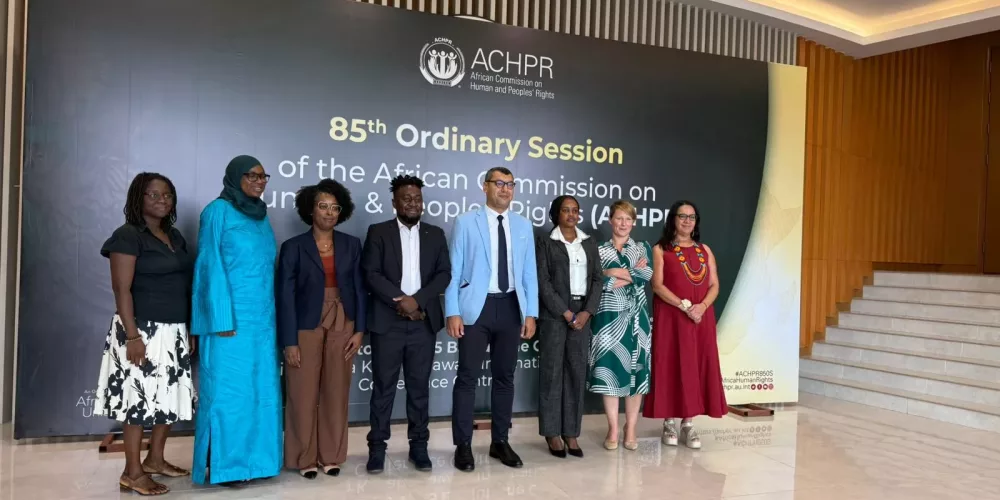
On 20 October 2025, Committee for Justice (CFJ) took part in a special panel discussion during the NGO Forum preceding the 85th Ordinary Session of the African Commission on Human and Peoples’ Rights (ACHPR), under the title:
“Enforced Disappearance and Reparations”.
The event was held in the Press Room of the International Conference Center in Banjul.
“Enforced Disappearance and Reparations”.
The event was held in the Press Room of the International Conference Center in Banjul.
The panel aimed to shed light on the urgent need for justice, accountability, and reparations for victims of enforced disappearance and their families in Africa and beyond, and to discuss relevant international and regional standards, gaps in current laws and practices, and opportunities for African Union and UN mechanisms and civil society to advance the rights to truth and remedy.
The discussion was moderated by Kelvin Kabaya, Senior Lawyer at Zimbabwe Lawyers for Human Rights (ZLHR), and brought together the following speakers:
-
Aua Baldé – Member of the UN Working Group on Enforced or Involuntary Disappearances (WGEID);
-
Ana Lorena Delgadillo Pérez – Member of the UN Working Group on Enforced or Involuntary Disappearances;
-
Sarah Peeters – Programme Officer, Development of the Legal Profession, Pan African Lawyers Union (PALU);
-
Sirra Ndow – Head of the Gambia Office, African Network against Extrajudicial Killings and Enforced Disappearances (ANEKED);
-
Ahmed Mefreh – Executive Director, Committee for Justice (CFJ);
-
Idah Muli – Director, Arise and Thrive Africa.
In his intervention, CFJ’s Executive Director stressed that the right to reparation cannot be separated from the rights to truth, effective investigation and guarantees of non-repetition. He highlighted CFJ’s experience in documenting cases of enforced disappearance and using UN and African regional mechanisms to support victims and families, particularly in Egypt, North Africa and the Sahel.
Panelists addressed a range of key issues, including:
-
the legal and practical obstacles that hinder states from acknowledging responsibility for enforced disappearances;
-
the limitations of existing national reparation frameworks and ways to align them with international and African human rights standards;
-
the need to meaningfully involve victims and families in the design and implementation of reparation programmes;
-
the role of national courts and regional and UN mechanisms in delivering justice and strengthening guarantees of non-repetition.
The event was co-organised by:
-
International Service for Human Rights (ISHR);
-
Committee for Justice (CFJ);
-
DefendDefenders;
-
Zimbabwe Lawyers for Human Rights (ZLHR);
with the support of the UN Human Rights Council Special Procedures.
Committee for Justice affirms that this discussion is an important step in bringing together civil society, African and UN mechanisms to advance truth, justice and reparation for victims of enforced disappearance and their families, and to send a clear message that this crime does not lapse with time and must never go unpunished.