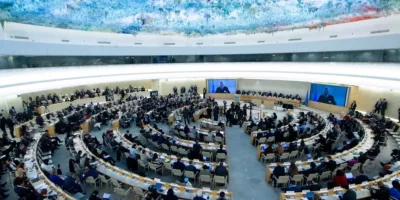



The Committee for Justice (CFJ) has submitted a written statement during the 61st session of the United Nations Human Rights Council under Agenda Item 3, addressing the systematic use of torture against political prisoners and prisoners of conscience in Egypt.
In its submission, CFJ examines patterns of physical and psychological torture inside places of detention, particularly Badr Correctional and Rehabilitation Center, highlighting prolonged solitary confinement, denial of family visits and legal access, continuous surveillance, and medical neglect as measures amounting to torture and ill-treatment.
The statement further documents the use of enforced disappearance by the National Security Agency as a structural tool enabling torture, including prolonged secret detention, coercive interrogations, and confessions extracted under severe abuse. It also addresses the failure of prosecutorial and judicial authorities to investigate allegations of torture, the routine dismissal of complaints, and the acceptance of confessions obtained under coercion.
CFJ underscores that torture in Egypt is not incidental but systemic, sustained through institutional practices and judicial complicity. The organization calls on the Council and the Special Rapporteur on torture to ensure sustained monitoring and follow-up, and urges the Egyptian authorities to end torture, cease enforced disappearance, guarantee accountability, and release all individuals arbitrarily detained for the peaceful exercise of their rights.
The full written statement is available below.
Skip to PDF content

![Prison bars at Colchester Castle [William Warby/Flickr]](https://www.cfjustice.org/wp-content/uploads/2021/10/3256155178_41f3d75af0_o-scaled-e1635705415103-400x200.jpg "Prison Bars")